


Python vs JavaScript: Which One Should You Choose for Web Development?
When it comes to Python and JavaScript, they are two programming languages that define the web but serve drastically different roles. JavaScript is the king of the front end, where everything the user sees and interacts with is operated through JavaScript. Whether it’s a button that changes the website’s content or a live chat interface, JavaScript is the language of the browser that lets websites become dynamic and functional.
Python, on the other hand, runs the server side of the application. It’s great for data, servers, and performing logic on the backend. With Python-based frameworks like Flask and Django, a developer can create a secure, scalable web application that can do much more than just show static pages.
So when it comes to web development, the question isn’t which is better; it’s what do you want to build? Let’s unpack where each language shines and how to choose the right one for your next project.
JavaScript: The King of the Front End
If you want to build rich, interactive, real-time user interfaces, then JavaScript is not debatable. It is the default language for client-side programming because browsers know how to interpret JavaScript natively.
Over the years, JavaScript frameworks such as React, Angular, and Vue have revolved around how developers build web interfaces. These frameworks allow developers to create components that update dynamically when data changes, creating a more fluid and responsive web experience.
Then there’s Node.js – JavaScript’s port to the server world. With Node.js, developers can use JavaScript for both client-side and server-side programming. This is especially helpful to achieve high performance for full-stack JavaScript applications. Netflix, LinkedIn, and PayPal all use Node.js for high-performance web applications.
So, in brief, if your app depends on heavy client-side interactivity or real-time updates, JavaScript is an irreplaceable language!
Python: The Powerhouse of the Backend
JavaScript may be the reigning champion of the browser, but Python is far more impactful out of sight. From its clean syntax to an extensive library ecosystem, it’s also one of the easiest languages to learn, and it’s not only for web development.
For Python Development, Django and Flask are frameworks that make it easy to develop scalable web applications. Django includes everything from auth to ORM – all useful for enterprise-quality platforms, whereas Flask will give you the flexibility you need for lighter-weight web apps or APIs.
Do you want to support machine learning models in your web application? The libraries available in Python for machine learning, such as TensorFlow, Pytorch, and Scikit-learn, are unparalleled.
Do you want to develop automation scripts or data analytics? Python does both equally or better than virtually every other programming language on the planet.
That is why many companies, such as Instagram, Pinterest, and Spotify, rely on Python for the server-side components of their web applications.
Comparing the Two: Python vs JavaScript in Action
Syntax and Learning Curve
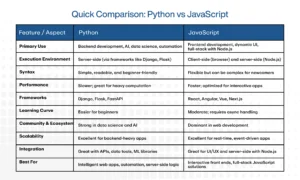
Beginners often choose Python because of its simplicity. Python is almost written like English, making it suitable for new developers or teams who want code that is maintainable across the lifespan of an application. A Python script to make an API request or query a database can be easily written in fewer lines than it takes in JavaScript.
On the other hand, JavaScript has a few quirks you may have to learn to work around. The asynchronous nature of this language – callbacks, promises, async/await can be a little daunting at first. But once you get the hang of it, you can do some powerful things with JavaScript, like data fetching in a browser, as well as animations, or even user input.
In short:
- Python is clean, readable, and great for logic-heavy tasks.
- JavaScript is flexible, fast, and optimized for user interaction.
Performance and Speed
JavaScript tends to be the fastest option when it comes to raw execution speed, particularly on the client-side. Improving JavaScript engine performance, such as Google’s V8 (used in both Chrome and Node.js), makes JavaScript particularly strong for building applications that require quick responses, such as chat apps or online games.
Python is an interpreted language; it will be slower by default. But, performance isn’t just related to speed – it is also related to scalability and reliability.
In scenarios where the backend is doing the heavy lifting or where data is processed and loaded in multiple steps, Python’s performance and readability enable teams to develop and deploy maintainable, stable systems quickly and with fewer issues.
If your application will be heavy on user interaction, stay with JavaScript. If your application will be heavyweight (i.e., heavy data processing or complex business logic), Python app development is the clear choice.
Ecosystem and Community Support
Both Python and JavaScript have large community followings globally. However, there are slight divergences in their ecosystems.
The JavaScript ecosystem is front-end focused, offering a wide variety of libraries, tools, and JavaScript frameworks specifically for UI, DOM manipulation, and integrating APIs. Arguably, the largest software registry in the world is NPM (Node Package Manager).
Python covers a wider ecosystem and has a slant toward backend, data science, and automation. Libraries such as Django, Flask, Pandas, and NumPy allow for greater versatility beyond just web apps for Python development.
In concrete terms:
- JavaScript’s community allows you to build things that users see.
- Python’s community allows you to build things that make them work.
Integration and Use Cases
When developing a full-stack application, the optimal solution isn’t Python vs JavaScript, it’s Python and JavaScript. The two languages work quite well together.
For example:
- Use JavaScript (React or Vue) for your front end.
- Use Python (Django or Flask) for your backend.
- Connect them through APIs for a seamless integration.
By developing a full-stack application this way, both ecosystems can be used to their fullest potential: the interactivity of JavaScript, and the app development power of Python.
When to Choose Python vs JavaScript
So, here is the bottom line: one language is not better than another. It’s simply about the problem you are trying to solve.
Use Python if you are:
- Creating complicated backends, APIs, or data-driven apps.
- Creating AI tools, using machine learning, or building automatic processes.
- If simplicity, scalability, and maintainability are top priorities.
Opt for JavaScript if you are doing the following:
- Creating interactive, real-time, or dynamic front ends.
- Building browser-based applications.
- Looking for a single full-stack framework on Node.js.
Or if you want the best of both, merge them. Today, many high-performing applications rely on both Python and JavaScript to build a fast, intelligent, and scalable web application.
Final Thoughts
The battle between Python and JavaScript has nothing to do with superiority and everything to do with context. JavaScript is the clear leader when we think of the front-end and interactive web experiences, while Python works on the back-end of an application to provide structure, stability, and intelligence.
Both languages are continuously changing, along with their respective ecosystems, and influence each other. The best approach is not to take a side, but to understand the strengths of both languages. Whether you take on Python Development, JavaScript development, or both, the goal is really the same: to build something fast, intelligent, and valuable for your users.
Choose GKM IT: Python and JavaScript Experts
At GKM IT, we combine these two worlds. Our developers specialize in Python app development and JavaScript frameworks; they’re deeply experienced in developing end-to-end digital solutions that are efficient, scalable, and future-ready. From smart backends to dynamic frontends, our web applications perform flawlessly while also being expandable as your business thrives.
So in the end, Python does not compete with JavaScript; they’re a perfect pairing. And with GKM IT at your side, you don’t have to choose: you get the best of both worlds, strategically paired to fuel your next big idea.
Related Blogs:
Top Vue.js Frameworks and Libraries That Simplify Frontend Development
Why ReactJS is the Go-To Front-End Framework for Modern Web Development


