


Node.js vs Java: Why Node.js Is the Future of Scalable Web Development
In today’s connected world, backend technologies are crucial. They determine how quickly, securely, and efficiently your applications can grow. Whether you have a real-time chat app, an IoT network, or an online store, a high-end backend can significantly impact your product’s success.
For many years, Java has been the go-to language for enterprise systems. It is reliable, tested, and secure. However, over the last ten years, Node.js has changed the web development game. It is lightweight, very fast, and designed for real-time, cloud-based applications.
Nowadays, many developers are switching from Java to Node.js. Let’s explore how Node.js is changing software development, its advantages over Java, and the situations where Java is still a good choice.
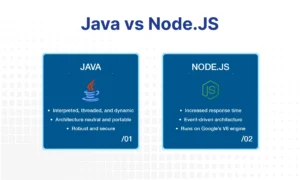 When choosing between Node.js and Java, the answer depends on what you’re building. Both are powerful, but they’re designed for different priorities.
Understanding Node.js Architecture
One of the main reasons Node.js development is still growing is that its architecture is both simple and efficient. Let’s figure out how it works:- Single-threaded Event Loop: Unlike Java, which spawns multiple threads, Node.js executes on a single thread. It doesn’t stop each request; instead, it puts tasks in a queue and responds when they’re done.
- Asynchronous Processing: Tasks like reading files, making network calls, or querying a database happen at the same time, which makes the whole application run more smoothly.
- Event-driven Design: Node’s event loop makes sure that multiple requests are handled smoothly, which is great for apps that need to work in real time.
- V8 Engine Performance: Node.js uses Google’s V8 engine to turn JavaScript into highly optimized machine code, which makes it run very quickly.
Top Use Cases for Node.js Web Development
Modern businesses are drawn to Node.js for its combination of speed, scalability, and real-time performance. Here are some of the most common scenarios where Node.js shines:- Streaming Platforms: Node.js makes video streaming and live sports updates smooth and easy to use, thanks to its ability to handle many tasks at once.
- Real-Time Applications: Messaging apps, online games, and dashboards use Node.js to support thousands of active users at the same time.
- APIs and Microservices: Node.js works well for building APIs and microservices because it is fast and has a flexible design.
- E-commerce Platforms: Node.js can manage busy sales events without crashing or slowing down.
- IoT Systems: Node.js easily manages large networks of devices and keeps data flowing constantly.
What Makes Node.js Stand Out?
Node.js is a JavaScript runtime based on Google Chrome’s V8 engine. It allows developers to write both client-side and server-side code using JavaScript. This creates a single development environment. Using one language makes it easier for teams to work together. Developers for both the frontend and backend can collaborate more smoothly. This speeds up project delivery and reduces the difficulties of transferring work between teams.Node.js Benefits That Drive Modern Applications
1. Non-blocking for high-performance I/O
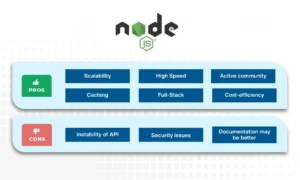
Node.js doesn’t use traditional multi-threaded systems; instead, it uses an event-driven and non-blocking architecture. This lets it handle thousands of requests at once without having to make a new thread for each one. This means that Node.js is faster and more efficient than older systems for things like streaming platforms, chat servers, and real-time dashboards.2. A unified tech stack speeds up development.
One of the best things about Node.js is that it makes developers more productive. JavaScript runs across the whole stack, so teams write less boilerplate code, find and fix bugs faster, and release new versions faster than ever. This is why agile product teams and startups that want to move quickly without losing quality love Node.js.3. Easy to Scale
Node.js doesn’t use heavy threads that can block other threads. Its asynchronous operations allow developers to scale applications easily by adding more servers to handle increased users without overloading the system. This makes it a good option for businesses that need to manage sudden spikes in traffic or rapid growth.4. Huge npm ecosystem
The npm registry is one of the biggest open-source ecosystems in the world. It is Node’s package manager. Developers never start from scratch because there are more than a million pre-built modules. There is a package for just about everything, from authentication to analytics to AI integration. This huge ecosystem speeds up development cycles and cuts down on time to market.5. Support for businesses and communities that are full of life
Node.js thrives on one of the most active open-source communities, constantly improving performance and security. Leading enterprises like Netflix, PayPal, Uber, and Walmart rely on it for high-traffic, mission-critical applications. This strong ecosystem ensures ongoing innovation, rich library support, and dependable performance, making Node.js a truly future-ready choice for modern web development.Node.js vs. Java: Which One Fits Your Project?
When choosing between Node.js and Java, the answer depends on what you’re building. Both are powerful, but they’re designed for different priorities.
| Parameter | Node.js | Java |
| Language | JavaScript (frontend + backend unified) | Java (classic enterprise backend) |
| Architecture | Non-blocking, event-driven | Multi-threaded, blocking I/O |
| Performance Focus | High-speed handling of I/O and real-time data | Excellent at CPU-intensive and background tasks |
| Development Speed | Rapid, ideal for startups and microservices | Slower, suited for complex enterprise systems |
| Scalability | Horizontal scaling built into the event loop | Vertical scaling with distributed systems |
| Learning Curve | Easier for JS developers | Requires Java and JVM expertise |
| Best Use Cases | APIs, real-time streaming, cross-platform tools | Financial, banking, and heavy transactional apps |
Verdict: Node.js for the Real-Time Era
When your business depends on real-time responsiveness, like tracking user actions, managing live data, or serving thousands of simultaneous users, Node.js leads the way. It’s lightweight, fast to deploy, and built for modern, distributed environments. That said, Java continues to dominate in sectors that value bulletproof security, regulatory compliance, and heavy computational tasks. Financial institutions, government systems, and legacy enterprises still rely on Java’s stability and decades of refinement. The smartest approach? Many enterprises today blend both technologies, using Java for complex core systems and Node.js for APIs, web layers, or customer-facing microservices. This hybrid model delivers the best of both worlds: agility without losing reliability.Can Node.js Work with Java?
Yes. Node.js for Java integration is a growing practice, allowing teams to reuse Java logic while gaining Node’s agility for the frontend server layer. You can combine both technologies in several ways:- Build REST APIs in Node.js that call Java-based backend services.
- Use messaging queues (like RabbitMQ or Kafka) to allow seamless async communication.
- Host your frontend microservices on Node.js while retaining Java for legacy or secure data operations.


